
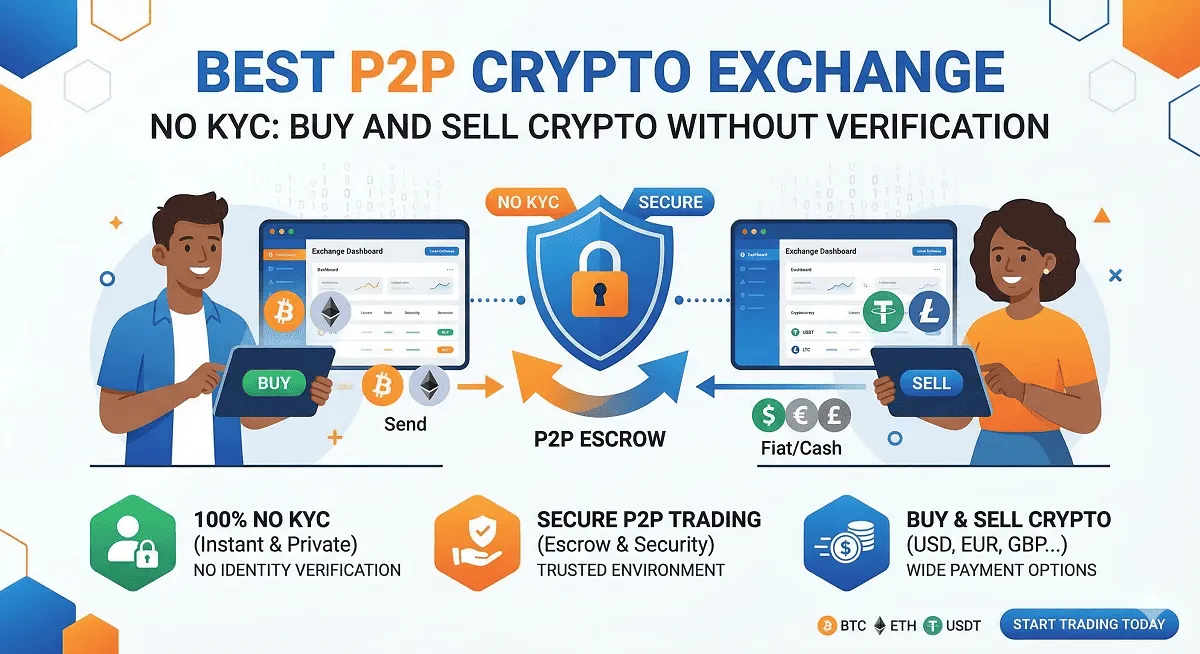
On many traditional crypto exchanges, users must complete a process called KYC (Know Your Customer). This usually means uploading documents like a passport or ID card. Then, the platform will check this information before allowing users to trade.
However, the cryptocurrency market is now growing quickly. Many people want to buy and sell digital money, but they also want to keep their personal information private. One way to do this is by using a P2P crypto exchange with no KYC. On these platforms, people can trade crypto directly with other users without showing their identity.
Keep reading to know more about what a P2P crypto exchange is, what “no KYC” means, the benefits and risks of using these platforms, and some of the best no KYC crypto exchanges available today.
What Is a P2P Crypto Exchange?
A peer-to-peer (P2P) crypto exchange is a platform where people buy and sell cryptocurrency directly with each other. There is no central company controlling the trade between the buyer and the seller.
On a P2P platform, users create offers to buy or sell crypto. Other traders can see these offers and choose one that matches their needs. When both sides agree on the price and payment method, the trade begins.
Most P2P exchanges use an escrow system. This means the platform temporarily holds the cryptocurrency until the payment is confirmed. After the buyer sends the payment and the seller confirms it, the crypto is released to the buyer.
Some common features of a P2P crypto exchange include:
Direct trading between users
Flexible payment methods such as bank transfer, e-wallets, or cash
Negotiable prices between buyers and sellers
Escrow protection to reduce the risk of fraud
Because people trade directly with each other, some platforms allow users to trade with little or no identity verification. This is why many traders who care about privacy choose P2P no KYC exchanges.
What Does “No KYC” Mean in Crypto Trading?
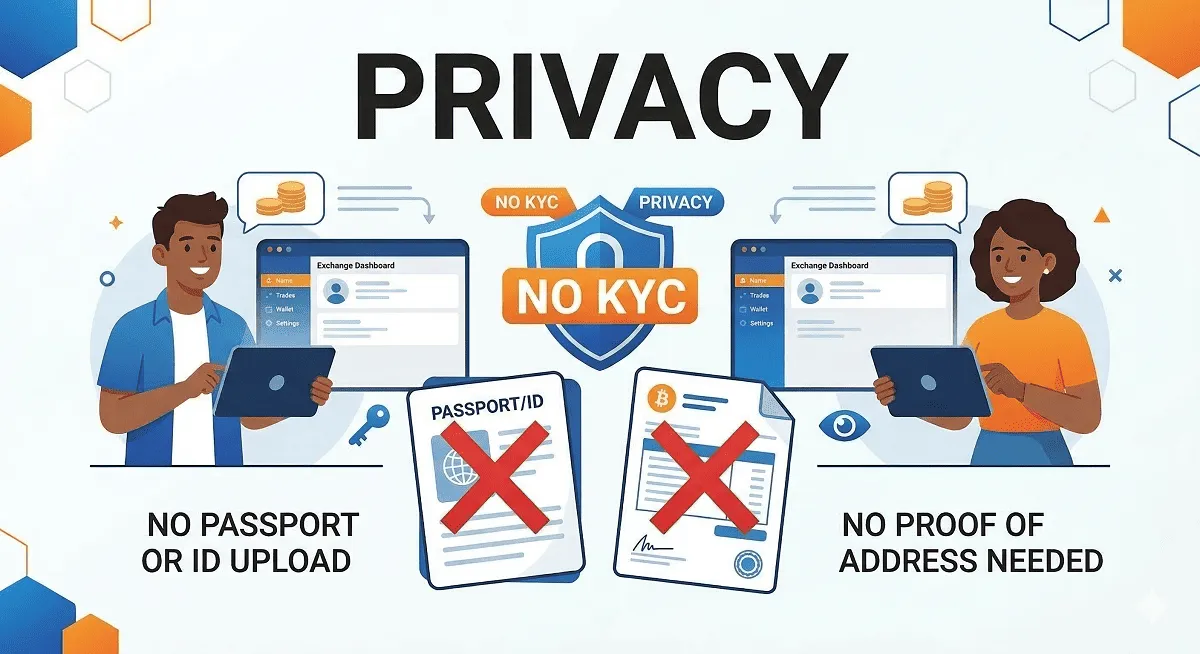
KYC stands for Know Your Customer. It is a process used by banks and crypto exchanges to check the identity of their users. To complete KYC, users usually need to send personal documents such as:
A government-issued ID (passport or ID card)
A selfie for identity verification
Proof of address
Unlike KYC, a P2P crypto exchange no KYC platform does not require identity verification at all or allows users to trade within certain limits without completing the KYC process. Many people like this system because it protects their privacy.
However, some platforms may still ask for verification if users trade large amounts of cryptocurrency.
In general, no-KYC trading offers several benefits:
Better privacy
Faster account setup
Fewer restrictions for users
But traders must also be careful. Because there is less verification, users need to protect themselves and watch out for possible scams.
Top P2P Crypto Exchange No KYC Platforms
Here are some of the most popular platforms that support peer-to-peer crypto trading with limited or no KYC requirements.
Bisq
Bisq is a decentralized Bitcoin exchange that focuses on privacy and security. Some key features of Bisq include a fully decentralized platform where users trade directly with each other without a central authority.
The platform does not require identity verification, which helps protect user privacy. Bisq is also open-source software, meaning anyone can review and check its code. In addition, it has a built-in system to help solve disputes between traders if problems happen during a transaction.
Hodl Hodl
Hodl Hodl is another well-known P2P Bitcoin trading platform that allows users to trade without identity verification.
Its escrow system uses multi-signature contracts. It means the platform never holds user funds directly.
Some highlights include:
Non-custodial trading system
No KYC requirement for most trades
Global user base
Transparent fee structure
This design makes Hodl Hodl attractive for traders who prefer maximum control over their funds.
Paxful
Paxful is one of the largest peer-to-peer crypto marketplaces. It supports a wide variety of payment methods, including bank transfers, mobile wallets, and even gift cards.
With Paxful, traders can get various features, including a large global trading community, hundreds of payment options, user rating and reputation system, escrow protection for transactions.
While Paxful may require verification for higher trading limits, many users can still conduct smaller transactions with minimal identity checks.
LocalCoinSwap
LocalCoinSwap is a multi-cryptocurrency P2P exchange designed to support privacy-focused trading.
The platform allows users to buy and sell several cryptocurrencies directly with other traders using local payment methods.
Benefits include:
Support for multiple cryptocurrencies
Optional identity verification
Community-driven platform
Profit-sharing model for token holders
LocalCoinSwap aims to provide a decentralized marketplace while maintaining a simple and user-friendly trading experience.
Peach Bitcoin
Peach Bitcoin is a newer P2P platform made for private Bitcoin trading. It helps people buy and sell Bitcoin directly with other users.
The platform focuses on privacy and simple use. It is designed mainly for mobile phones, so users can trade easily and safely from their devices.
Some advantages of Peach Bitcoin include no mandatory KYC, a simple mobile trading interface, and direct peer-to-peer matching between buyers and sellers.
Risks of Using P2P Crypto Exchange No KYC
Using a P2P crypto exchange no KYC can give users more privacy, but it also comes with some risks.
One common risk is scams. Because users trade directly with other people, there is a chance that dishonest traders may try to cheat others. Another risk is limited customer support. Some P2P no KYC platforms do not have strong support teams, so solving problems may take more time.
There is also regulatory uncertainty. Cryptocurrency rules are different in each country, and some governments may restrict or monitor no-KYC trading. Finally, some platforms may have liquidity issues. This means there may be fewer buyers and sellers, so trades can take longer to complete.
For these reasons, traders should always be careful and use trusted platforms.
Tips for Safe Trading on No-KYC P2P Exchanges
To trade safely on best no KYC crypto exchanges, consider the following tips:
use escrow services
check trader reputation
start with small transactions
avoid off-platform communication
stay alert for suspicious offers
Following these practices can help minimize the risks.
In conclusion, a P2P crypto exchange no KYC can be a good option for traders who want more privacy and faster access to the crypto market. If you are new to no-KYC trading and want to compare reliable platforms, you can visit Traderbbs, an independent broker comparison platform that helps traders find and review the best crypto exchanges.